Fashions and Music and Art in 1850
In this article, we discuss the study of style history, why London is one of the fashion capitals of the world, and how Great britain fashion has evolved over the decades.
Manner is a crucial and culturally important role of cocky-expression and can likewise be used as a tool of influence. As a event, fashion holds a lot of power – some of the world's biggest fashion icons like David Bowie, Billy Porter and Princess Diana have worn outfits that held a lot of cultural significance and influenced thousands of people.
British style, in item, has been a large influence on the global fashion world for many years, and then today we're exploring how fashion in the UK has changed since 1800. In this article, we'll talk over why y'all might want to report fashion history, why London is a global fashion capital and some of the greatest British designers. Finally, we'll dive into British mode over the decades.
Why study the history of fashion?
If yous're interested in fashion, then learning about way history is indispensable. This is because fashion is constantly irresolute and repeating itself, and designers are able to accept infinite inspiration from old collections , historic dress and fifty-fifty fine art and architecture.
Studying fashion techniques, materials, shapes, and designs from the past tin can assistance u.s.a. to understand cultural moments, predict future trends, and be creative with new designs. So if y'all desire to work in the fashion industry , learning well-nigh the history of fashion is crucial.
Even if you don't, but y'all're a lover of style, you lot might observe that you're able to develop your personal manner later on learning almost iconic fashion trends and moments.
Why is London i of the fashion capitals of the globe?
As we've previously mentioned, London is pretty big in the fashion earth. But how did it become a fashion uppercase, and how is the London mode scene different from other global cities? Well, for starters, London is one of the most multicultural, creative and open-minded cities in the earth.
This has a large impact on the fashion industry because it enables designers to be more artistic and innovative, and information technology fosters a level of openness that encourages variety and embraces cultural differences .
Dylan Jones, Editor-In-Primary of GQ magazine, claims that " what London has over the other fashion capitals is a 18-carat sense of eccentricity ". But where does this eccentricity, creativity and diversity in fashion come from, as well the brand-up of London itself?
London fashion schools
One of the biggest reasons why London stands out is because it has some of the all-time mode schools in the globe.
Key St Martins is the university of some of the biggest designers in the world, including Alexander McQueen, John Galliano and Christopher Kane. London Higher of Manner has alumni including Jimmy Choo, and Condé Nast College of Manner and Pattern has sent their graduates to companies including Moschino, Dior and Vogue.
Shopping in London
Thinking virtually London from a consumer perspective, the city likewise has some of the best shopping spots in the world. Oxford Circus is renowned for its bustling loftier street with every brand imaginable, but you lot tin can besides find vintage way a-plenty on Brick Lane, or designer brands in Chelsea or Freedom's department store. London'due south shopping potential is certainly another reason that the city is firmly on the global fashion map.
London Fashion Week (LFW)
Concluding, but not least, London Fashion Calendar week (LFW) has cemented London every bit 1 of the nigh influential fashion capitals in the world, alongside New York, Paris and Milan. It was established in 1984 past the British Fashion Council, and now takes place twice a yr. Having such a widely respected show brings all the big names to London – designers, models and celebrities alike.
Who are the biggest British fashion designers?
So many heady mode designers are from the UK, and designers have a pivotal role in fashion history. With that in mind, we thought we'd take the fourth dimension to briefly look at the influence of three of the biggest British way designers of the by few decades.
Alexander McQueen
McQueen is an incredible example of how manner success doesn't accept to come from starting out wealthy or having glory contacts. Growing up in a quango apartment in London, and leaving school with i O-Level in Art, he may not have seemed like a probable candidate for way royalty. All the same, he was the head designer of Givenchy, created his own menswear line in 2004, and fifty-fifty won British Designer of the Yr four times.
Sadly, Alexander McQueen took his own life in 2010, merely he continues to be known and appreciated for his anti-establishment mental attitude, subversive designs and catwalk shows, and impeccable tailoring.
Stella McCartney
She may have had a more than typical beginning to the way world than McQueen, being the girl of a celebrity and obtaining a degree from Fundamental St Martins, but Stella McCartney undoubtedly became a British fashion icon in her ain right.
Non only is she recognisable for her women'southward tailoring and blurring of masculine and feminine, merely she also was one of the first large designers to have a stance against using leather, fur, feathers or any other animate being products in her clothing. Her pioneering approach to sustainable practices, respect for animals, and blurring of gender binaries have helped to secure her equally a British icon.
Vivienne Westwood
A way icon since the 1970s, Vivienne Westwood is a cocky-taught designer who started off selling vintage wearable with her husband, the manager of punk band The Sex Pistols. After some fourth dimension, Westwood congenital a proper noun for herself, designing multiple menswear and womenswear collections each year alongside many other fashion collections.
Westwood's mode is known for existence unconventional and outspoken and heavily influenced by punk. She brought fashion accessories such as safety pins and bondage into the mainstream, uses political slogans in her vesture, and innovates with traditional fabrics such as tweed, tartan and tulle.
In 2004, the Victoria and Albert (V&A) Museum in London held the largest exhibition always devoted to a British fashion designer, called "Vivienne Westwood: 34 years in Style".
A timeline of British style history since 1800
Now it'southward time to delve into British fashion over the decades and see how history influences current and hereafter trends. We'll briefly go over 19th-century fashion before looking at each decade throughout the 20th and 21st centuries in more detail.
Keep in mind that British style was influential and culturally important well earlier this time. Fashion changed throughout the centuries, spanning medieval England, Tudor times and the Victorian era. British Royal fashion played a large role in inspiring wider trends, something we tin nevertheless recognise in recent times with Princess Diana, Kate Middleton and Meghan Markle becoming fashion icons.
However, to explore U.k.'south entire history of fashion would require a very long commodity, so today nosotros'll be focusing on more than contempo times, with help from the Five&A Museum's learning materials .
19th-century way
The finish of the 18th century saw the modernisation of article of clothing for men and women. Men still wore tailcoats but they were shortened, and women still wore corsets and gowns, but with a slightly more natural silhouette.
The clothing industry in London expanded, as materials and dyes came along on boats from corners of the British empire. This, along with the popularisation of the dwelling house sewing machine, allowed for more than freedom and bolder wearable designs in the post-Victorian period.
1900s style
Once nosotros get to the 1900s, we can run across that the corset is however fashionable for women. In item, an S-bend corset that pushed the hips back and breast forwards was popular, and could often be seen aslope frilly blouses with lace or ribbon embellishments. Separates were besides becoming common as an alternative to dresses.
Men by and large wore iii-slice suits with hats, so we tin can run into that British fashion during this time was still rather formal, without much room for self-expression.
1910s manner
In the 1910s was the outbreak of World War 1, and with that, everything changed for British fashion. People had to exist more economically restrained, and this led to the simplification of wear into something cheaper and more practical. This besides meant that the line between men and women'southward mode became more blurred.
The function of women experienced a huge upheaval, and they started to work on farms and in factories every bit function of the war effort. This meant that their clothing became more armed forces-inspired and practical to suit the work they were doing, and dresses also became simpler and looser.
1920s fashion
One of the near famous decades of British fashion, the roaring twenties began with anybody feeling a sense of prosperity and liberty after the stop of the state of war. Fashion became inspired by art deco architecture and golden features, and influence was taken from ancient civilisations – an enthrallment with ancient Egypt followed the discovery of Male monarch Tut's tomb in 1922.
Gone was the military dress of the previous decade, but some of the applied features of clothing stayed, with men and women wanting to feel comfortable even while they partied. Women often wore flapper dresses with dropped waistlines and ornate decorations, and men started to play with more colourful suits and bow ties.
1930s way
While the glamour of the 1920s stayed throughout the 30s, the most popular women's silhouette inverse from the more androgynous, shapeless flapper dress to a more than silky, form-fitting evening gown, often with a low dorsum. Decorative hats and collars were also popular at this time.
For men, the three-piece conform dropped even more than in popularity, being reserved only for formal events. Casual clothes such equally knitwear and open up-necked tops became more pop for daywear.
1940s fashion
With the Second Globe War came the reintroduction of more practical, military-inspired clothing. The United kingdom government even issued a utility scheme that listed a set of regulations on clothing to reduce the amount of fabric used. Both men and women wore outfits that mimicked utility uniforms, with features such every bit padded shoulders and lots of buttons.
To try and make utility clothing more than appealing, brilliant colours were introduced by designers, and the utilize of cheaper fabrics such as rayon began to rise.
1950s manner
In the 50s, the leading style for women was a dress with a cinched waist and very total skirt, made famous by Christian Dior. As time went on, pencil skirts became more common, and so dresses became more form-fitting.
Not also surprisingly, the adapt was still the centrepiece of men's fashion, just a new kind of "Teddy Boy" style became stylish as a result of working-class rebels who were inspired by Hollywood stars like James Dean. This ordinarily consisted of narrower trousers than usual, velvet blazers and brocade waistcoats.
1960s fashion
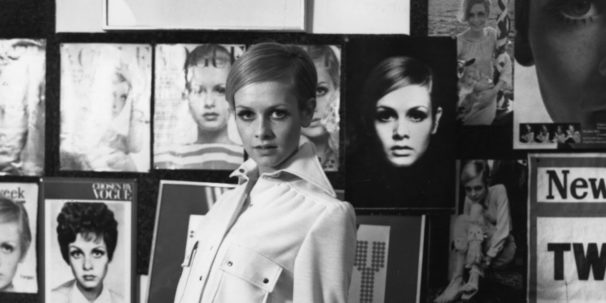
Fashion inverse dramatically in the 60s, with both womenswear and menswear becoming more casual than ever before. New clothing items like the miniskirt were created with young consumers in mind by designers similar Mary Quant – this was a upshot of "Swinging London", a miracle in the 60s based on youth civilization, music and fashion.
Playful colours and materials became more than popular, with designers using fabrics like polyester, acrylic and PVC. Regarding menswear, things had never looked more dissimilar. Apparel were more playful and colourful, trousers were wider, and shirts were printed. There was besides more of a blending between men and women's way.
1970s style
The 70s was a highly playful and explorative decade for fashion in the UK, with numerous styles being adopted. This included a hippie or boho style with tie dye, bell bottoms, prairie dresses and crochet condign pop, all of which was part of a motility away from mainstream mode and politics.
The punk motility was too a rejection of mainstream order simply with a rather unlike style; instead of crochet, punks wore tartan, leather and bondage. Disco too became popular in the 70s, and this meant that sequins, hot pants and miniskirts were all the rage.
Menswear kept getting more bold and colourful, with more printed shirts and blazers condign mainstream alongside increasingly slim-fitting trousers. The 70s, in particular, created a bunch of male British style icons, from Mick Jagger to David Bowie.
1980s fashion
Called by some as "the time that fashion forgot", the 80s were certainly an interesting time for British way, with many supposed fashion rules beingness ignored or broken. Understated was not a theme of the 80s, with some of the well-nigh pop trends consisting of shoulder pads, ability suits, and brilliant, lycra sportswear.
Denim likewise became more than popular than ever in this decade, with denim jackets and skirts becoming common alongside classic jeans. Similarly to women, menswear consisted of a lot of power dressing and sportswear, including tracksuits and windbreakers.
1990s fashion
In the 90s, style became more coincidental than ever, with both men and women favouring jeans and oversized clothing. Sportswear continued to inspire fashion, with items like biker shorts and big sweatshirts beingness a pop trend for women. There was also a surge in the popularity of vintage and 2nd-hand habiliment, frequently inspired past grunge.
Men were also increasingly inspired by grunge movements and bands like Nirvana, with flannel shirts, jeans and converse shoes existence common.
2000s style
This was the time that fast mode started to get pervasive in the UK and other western countries. A lot of clothes started to be inspired past celebrity culture, and they were made as cheaply and quickly as possible. Y2K trends such every bit mesh tops, wide-leg trousers, and bedazzled t-shirts were popularised, and nosotros're currently seeing a resurgence of these styles.
In the late noughties, there was even more fashion experimentation. Some trends were inspired by the 80s, such equally neon and geometric patterns, merely nosotros besides saw a rise in culling trends such as emo manner and scene. Some of the well-nigh popular noughties trends in the UK include skinny jeans, ugg boots, and chunky belts.
2010's manner
This decade is when things started to change, and the style earth has continued to see a full upheaval in how fashion is worn, designed and marketed e'er since. With the rise of social media, influencer culture, and eventually sustainability and eco-friendly fashion, we've seen meaning changes throughout the manufacture.
In that location are still some notable trends of this decade worth mentioning, however. From festival style with fringing and blossom crowns, to millennial pink everything, to the rise of the trainer, fashion has constantly been on the motility, and we continue to see trends from previous decades being recycled.
British fashion today
The movement towards sustainability , minimising waste, and wearing skilful quality vesture has continued from the end of the 2010s. Notwithstanding, the fast style empire has also continued to ascension, and so we're now seeing the tension between these two approaches to fashion into the 2020s.
Nosotros can only promise that the U.k. continues to be creative and innovative in their mode designs while thinking about the toll of style to the planet, boyfriend creatures and hereafter generations. Y'all can read more than nearly sustainability in the manner industry in our previous blog post.
Hopefully, this article has inspired yous to learn fifty-fifty more about British manner history and peradventure lent you some inspiration for your ain designs.
0 Response to "Fashions and Music and Art in 1850"
Post a Comment