What Is the Fashion in the 80S Called

Fashion of the 1980s placed heavy emphasis on cheap clothes and style accessories and very big poofy hair. Wearing apparel tended to be very bright and vivid in appearance. Punk fashion began every bit a reaction against both the hippie motion of the past decades and the materialist values of the current decade.[2] The first half of the decade was relatively tame in comparison to the second half, which is when the iconic 1980s color scheme had come into popularity.
Hair in the 1980s was typically big, curly, bouffant and heavily styled. Television shows such as Dynasty helped popularize the high volume bouffant and glamorous image associated with it.[3] [4] Women in the 1980s wore bright, heavy makeup. Everyday fashion in the 1980s consisted of light-colored lips, dark and thick eyelashes, and pinkish or red rouge (otherwise known as blush).[v] [6]
Some of the peak fashion models of the 1980s were Brooke Shields, Christie Brinkley, Gia Carangi, Joan Severance, Kim Alexis, Carol Alt, Yasmin Le Bon, Renée Simonsen, Kelly Emberg, Ines de la Fressange, Tatjana Patitz, Elle Macpherson, and Paulina Porizkova.[ citation needed ]
Women'southward manner [edit]
Early 1980s (1980–1982) [edit]

Minimalism [edit]

Young woman in 1980 wearing a low-cut spaghetti strap dress.
- The early 1980s witnessed a backlash against the brightly colored disco fashions of the belatedly 1970s in favor of a minimalist arroyo to way, with less emphasis on accessories. In the Us and Europe practicality was considered just equally much every bit aesthetics. In the Uk and America wearable colors were subdued, quiet and bones; varying shades of chocolate-brown, tan, cream, and orange were mutual.[7]
- Stylish clothing in the early 1980s included unisex and gender-specific attire. Widespread fashions for women in the early on 1980s included sweaters (including turtleneck, crew neck, and 5-neck varieties); fur-lined puffer jackets; tunics; faux-fur coats; velvet blazers; trench coats (made in both fake and real leather);[7] crop tops; tube tops; knee-length skirts (of no prescribed length, equally designers opted for option); loose, flowy, articulatio genus-length dresses (with high-cut and low-cut necklines, varying sleeve lengths, and made in a multifariousness of fabrics including cotton, silk, satin, and polyester); loftier-waisted loose pants; embroidered jeans; leather pants; and designer jeans,[7] [8] [ix] though jeans were not as widely worn equally during the 1970s.[x] Women's pants of the 1980s were, in general, worn with long inseams, and by 1982 the flared jeans of the 70s had gone out of fashion in favor of directly leg trousers. Continuing a trend begun during the late 1970s, cropped pants and revivals of 1950s and early '60s styles like pedal-pushers and Capri pants were pop.[eleven] 1981 saw a brief fall vogue for knickers.[12]
- From 1980 until 1983 popular women's accessories included sparse belts, knee-high boots with thick kitten heels, sneakers, jelly shoes (a new trend at the time),[13] mules, circular-toed shoes and boots, jelly bracelets (inspired by Madonna in 1983),[14] shoes with thick heels, small, thin necklaces (with a variety of materials, such every bit gold and pearls), and small watches.[7]
Aerobics craze [edit]
- The fitness craze of the 1970s continued into the early 1980s. General women's street-wear worn in the early 1980s included ripped sweatshirts,[15] tights, sweatpants,[16] and tracksuits (particularly ones made in velour).[vii]
- Athletic accessories were a massive trend in the early 1980s, and their popularity was largely boosted by the aerobics craze. This included leg warmers, wide belts,[xvi] elastic headbands, and able-bodied shoes known as 'sneakers' in the US[17] or 'trainers' in the UK.[xviii]
Professional style [edit]
- In the 1970s, more women were joining the work force, and so, past the early 1980s, working women were no longer considered unusual. Every bit a way to proclaim themselves as equals in the job marketplace, women started to dress more than seriously at work. Popular clothes for women in the job market include articulatio genus-length skirts, broad-legged slacks, a matching blazer, and a blouse of a different color. Kitten-heeled shoes were frequently worn.[7] Formal shoes became more than comfortable during this period in time, with manufacturers adding soles that were more flexible and supportive.[19] The shoes with moderately spiked heels and relatively pointy toes from the very late 1970s remained a fashion trend.
Mid 1980s (1983–1986) [edit]
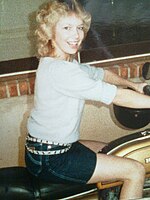
A young woman from the mid 1980s wearing a denim mini skirt with two thin belts.
Brilliant colors [edit]

- Women's way in the early 1980s became more than colorful around 1982. This included long wool coats, long flared skirts, slim miniskirts, slightly tapered pants and stirrup ones, designer jeans,[8] spandex cycling shorts,[xx] high waisted talocrural joint length jeans and pants manifestly or pleated, extremely long and beefy sweaters, jumpsuits, pastel colors, "off-the-shoulder" sweatshirts over tight jeans, leather trenchcoats, fur coats, extremely large scarves, beanies, leather gloves, and dresses worn with wide or sparse belts. The aerobics craze of the early 1980s continued into the mid 1980s, just the clothes became more colorful than they were earlier.
- Women's shoes of the mid 1980s included strappy sandals, kitten-heeled sandals, pumps, ballet flats, boat shoes, slouchy apartment boots, Keds, and white Sperry's sneakers.[7]
- In the 1980s, rising pop star Madonna proved to be very influential to female person fashions. She first emerged on the trip the light fantastic toe music scene with her "street urchin" look consisting of short skirts worn over leggings, necklaces, rubber bracelets, fishnet gloves, hairbows, long layered strings of chaplet, bleached, untidy hair with night roots, headbands, and lace ribbons. In her "Like a Virgin" stage, millions of young girls around the world emulated her fashion example that included brassieres worn equally outerwear, huge crucifix jewelry, lace gloves, tulle skirts, and boytoy belts.
- Gloves (sometimes laced or fingerless) were popularized by Madonna, as well as fishnet stockings and layers of beaded necklaces. Brusque, tight Lycra or leather miniskirts and tubular dresses were also worn, as were cropped bolero-manner jackets. Black was the preferred color. With the new fashion's nearly extreme forms, young women would forgo conventional outer-garments for vintage-style bustiers with lacy slips and several large crucifixes. This was both an exclamation of sexual liberty and a conscious rejection of prevailing androgynous fashions.
Power dressing [edit]

President Ronald Reagan and his wife, Nancy, are seen with Jacqueline Kennedy Onassis.
- The television prime number time shows Dallas and, in particular, Dynasty influenced increasingly oversized shoulder pads. Shoulder pads, popularized by Joan Collins and Linda Evans from the soap opera Dynasty were popular from the mid 1980s to the early on 1990s. Dallas, still, promoted displays of wealth involving jewelry and sparkling clothing.[21] Meanwhile, women's fashion and business shoes revisited the pointed toes and spiked heels that were popular in the 1950s and early 1960s. Some stores stocked canvas or satin covered fashion shoes in white and dyed them to the customer's preferred colour, preferably vivid colors.
- By this menstruation, women had become much more than confident in the workplace and had advanced in their careers. In this decade, women wanted to fit into higher direction levels past emulating a masculine appearance through way to look more capable. Hence, they would wear empowering garments that portrayed masculinity, thus making them seem more professional person by fitting in with the male majority. This would be accomplished with attributes such as wider shoulders with the aid of padding and larger sleeves.[22] Other items included dresses worn with skinny or thick belts, pleated or plain skirts, tights or pantyhose, above the ankle length pants sometimes worn with pantyhose or tights underneath, ballet flat dress shoes, long sweaters, boat shoes and slouchy apartment short length boots.
- After the western economic blast of the mid-1980s, the younger generation had a decreased influence in fashion every bit they had less of an affect on the market. The main consumer became the older generations that were more than financially stable and were influenced by international political news. Thatcherism was promoted in the Great britain by the British Conservative Party. The female leader of the British conservative party, Margaret Thatcher, in her power adapt quickly became one of the nearly well-known symbols of the 1980s. Suits worn by Thatcher were commonly single colour toned with a matching chapeau, jacket and skirt, that ends below the knee. A wide shoulder and pearl necklace was also part of her regular attire. Her political style was straightforward, constructive and sometimes criticized as not empathetic plenty. Only there is no doubtfulness that her appearance portrayed her ability, power and authority, which is what a lot of working women at that era desired.[23] [24]
Late 1980s (1987–1989) [edit]
Consumer-friendly fashions [edit]
- From 1987 until the early on 1990s, the mini skirt was the merely length supported past fashion designers. Although skirts of any length were acceptable to wear in the years earlier, all attending was given to the short skirt, especially among teenage girls and young women worn with tights, pantyhose, leggings, or slouch socks. Shoulder pads became increasingly smaller.[7] Accessories pop in Uk, French republic and America included bright-colored shoes with thin heels, narrow multicolored belts, berets, lacy gloves, beaded necklaces, and plastic bracelets.[7]
- Women'southward wearing apparel in the belatedly 1980s included jackets (both cropped and long), coats (both cloth and fake fur), reversible inside-out coats (leather on ane side, simulated fur on the other), rugby sweatshirts,[7] sweater dresses, taffeta and pouf dresses, babe doll dresses worn with capri leggings or bike shorts, slouch socks, and Keds or Sperrys or with opaque tights and flats or opaque tights and slouch socks, neon or pastel colored shortalls, denim pinafore dresses, Keds, Sperrys, ballet flats, jumpsuits, oversized or extra long t-shirts, sweaters, sweatshirts, blouses and button down shirts popularly worn with leggings and stirrup pants, miniskirts, stretch pants, tapered pants, high waisted ankle length jeans and pants plainly or pleated skirts worn with leggings,[25] [26] dressed up leggings outfit of leggings with an oversized v-neck sweater over a turtleneck, slouch socks, Keds (shoes) or Sperrys, and bangs with a headband ring or ponytail and scrunchie, happy pants (homemade pants made in bold designs with vivid colors), and opaque tights.[7] Popular colors included neon hues, plum, gold, pinks, blues and bright wines.
Asian fashion [edit]
- In Mainland Red china, the unisex Zhongshan accommodate[27] declined subsequently the decease of Mao Zedong,[28] the removal of the Gang of 4, and the liberalisation of merchandise links and international relations during the mid and late 80s. Wealthier Chinese women began wearing Western inspired fashions once again,[29] including crimson or xanthous miniskirts[30] in addition to the more typical shirt dresses, white plimsolls and dacron blouses.[31]
- The belatedly 1980s also witnessed the ancestry of Indo Western fashion and the haute couture mode in Bharat that would eventually proceeds global recognition in the 90s. Colors like red and white[32] were popular, ofttimes with intricate embroidery. Although most women connected to wear the saree, Bollywood actresses also had access to Western designer outfits and locally designed garments like the Anarkali ballgown.[33]
- Japanese fashion designers Yohji Yamamoto, Rei Kawakubo , and Issey Miyake started a new school of fashion during the tardily 1980s[34] called "Japanese Avant-garde Fashion", which combined Asian cultural inspiration with mainstream European fashion. The Japanese spirit and civilisation that they presented to Europeans caused a manner revolution in Europe which continued to spread worldwide.[35] Yamamoto, Kawakubo and Miyake redefined the concepts of deconstruction and minimalism that were used in manner blueprint worldwide[36] by pioneering monochromatic, androgynous, asymmetrical, and baggy looks.[37] Additionally, the designs were unisex which were inspired by the pattern of traditional Japanese kimono. According to Lord's day, "Traditional Japanese kimonos don't have strict rules for menswear or women's article of clothing, therefore, for the basic way, kimonos have similar fashion and decoration for men and women".[36] Geometric diamond patterns, horizontal stripes, crinolines, layered kimono inspired blouses, dresses made from a single slice of fabric,[38] drop crotch Thai fisherman pants, space age inspired laser cut outfits, mesh, jackets with kanji motifs, and monochromatic black and white outfits were common, as was the apply of the traditional Japanese colors ruddy, mizudori and sora iro .[39] [ unreliable source? ] In The Japanese Revolution in Paris Manner, Kawamura describes this new concept: "[...] traditionally in Japanese society, sexuality is never revealed overtly, and this ideology is reflected in the style of kimono, particularly for women, these avant-garde designers reconstructed the whole notion of women's clothing style; thus they practise non reveal sexuality, just rather conceal it just like the kimono".[forty] [ unreliable source? ] The three designers gear up the stage for the beginning of postmodern interpretation on the part of those who design clothes that interruption the purlieus betwixt the West and the Due east, manner and anti-manner, and modern and anti-modern.[40]
Men'south fashion [edit]
Early 1980s (1980–1982) [edit]
Able-bodied article of clothing [edit]
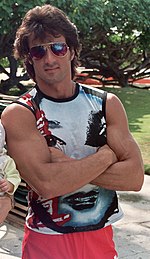
- In the early 1980s, way had moved away from the unkempt hippie look and overdressed disco style of the late 1970s. Athletic clothes were more than popular than jeans during this menses, as were more than subdued colors. Pop colors were black, white, indigo, forest light-green, burgundy, and different shades of browns, tans, and oranges. Velour, velvet, and polyester were popular fabrics used in clothes, especially button-upwardly and v-cervix shirts. Looser pants remained popular during this fourth dimension, being fairly broad but directly, and tighter shirts were especially popular, sometimes in a cropped able-bodied way. The general public, at this time, wanted to wear low-maintenance clothing with more than basic colors, every bit the global recession going on at the fourth dimension kept extravagant clothes out of reach.[7] Also worn were striped tube socks sometimes worn with the superlative folded over worn with shorts. It was not uncommon to run across parents peculiarly fathers wearing these forth with their kids.
- Popular wearable in the early 1980s worn by men included tracksuits,[41] 5-neck sweaters, polyester and velour polo-neck shirts, sports jerseys, direct-leg jeans, jeans rolled to show off their slouch socks, polyester push-ups, cowboy boots,[42] beanies, and hoodies. Effectually this fourth dimension it became acceptable for men to wear sports coats and slacks to places that previously required a suit.[seven] In the U.k., children's trousers remained flared, merely only slightly.
New moving ridge influence [edit]
- From the early to mid 1980s, post-punk and new moving ridge music groups influenced mainstream male and female fashion. Commercially made slim-plumbing fixtures suits, thin neckties in leather or assuming patterns, striped T-shirts, Members Just jackets, clubwear, metallic fabric shirts, cat middle glasses, horn rim glasses with brightly colored frames, androgynous neon colored makeup,[43] and pristine leather jackets were widely worn.[44] Common hairstyles included a short quiff for men, or teased big hair for women, and typical unisex colors for clothing included turquoise, teal, ruddy, neon yellow and white on a blue screen.
Preppy look [edit]
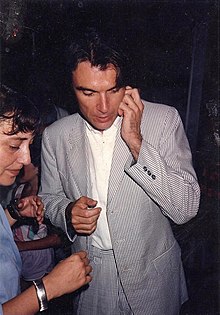
- In response to the punk fashion of the mid-late 1970s,[9] at that place was a throwback to the 1950s Ivy League style. This revival came to be definitively summarized in an enormously pop paperback released in 1980: The Official Preppy Handbook. Pop preppy habiliment for men included Oxford shirts, sweaters, turtlenecks, polo shirts with popped collars,[9] khaki slacks, argyle socks, clothes pants, Hush Puppies Oxford shoes, Sperrys boat shoes, Eastland boat shoes, brogues, suspenders, seersucker or striped linen suits, corduroy, and cable knit sweaters that were often worn tied around the shoulders.[45]
Mid 1980s (1983–1986) [edit]
Miami Vice/Magnum P.I. look and Michael Jackson'due south influence [edit]
- In the mid 1980s, pop trends included wool sport coats, Levi 501s, Hawaiian shirts, shell suits, hand-knit sweaters, sports shirts, hoodies, flannel shirts, reversible flannel vests, jackets with the insides quilted, nylon jackets, gold rings, spandex cycling shorts,[20] cowboy boots,[42] Sperrys gunkhole shoes, Sperrys white sneakers, Eastland boat shoes, khaki pants with jagged seams,[7] and through the end of the decade high waisted ankle length jeans and pants plain or pleated.
- The mid 1980s brought an explosion of colorful styles in men'south clothing, prompted by tv set serial such as Miami Vice and Magnum, P.I.. This resulted in trends such as t-shirts underneath expensive adjust jackets with broad, padded shoulders, Hawaiian shirts (complemented with sport coats, frequently with tiptop-stitched lapels for a "custom-tailored" wait), and (in counterpoint to the bright shirt) jackets that were often greyness, tan, rust or white. Easy-care micro-suede and corduroy jackets became popular choices, peculiarly those with a Western mode.
- Michael Jackson was also a large influence of teenage boys' and young men'due south fashions, such equally matching scarlet/black leather pants and jackets, white gloves, sunglasses and oversized, slouch shouldered faded leather jackets with puffy sleeves.
Power dressing [edit]

1940s inspired pinstripe adjust with big shoulder pads and double breasted fastening. These "power suits" were fashionable in United kingdom of great britain and northern ireland from the early 1980s until the tardily 1990s.
- Men'south business attire saw a return of pinstripes for the beginning time since the 1970s. The new pinstripes were much wider than in 1930s and 1940s suits but were similar to the 1970s styles. Three-piece suits began their turn down in the early 1980s and lapels on suits became very narrow, akin to that of the early 1960s. While vests (waistcoats) in the 1970s had commonly been worn high with half-dozen or five buttons, those made in the early 1980s ofttimes had simply 4 buttons and were fabricated to be worn depression.[46] [47] The thin ties briefly popular in the early '80s were presently replaced by wider, striped neckties, by and large in more than bourgeois colors than the kipper ties of the '70s. Double breasted suits inspired past the 1940s were reintroduced in the 1980s by designers like Giorgio Armani, Ralph Lauren, and Anne Klein.[46] [47] They were known every bit 'power suits', and were typically made in navy bluish, charcoal gray or air forcefulness blue.[46] [47] [48]
Tropical clothing [edit]

Mobutu wearing safari jacket, 1983.
- Every bit an culling to the power suit, the safari jacket, Nehru suit and Mao suit remained popular in Australia, South Africa, India, China, and Zaire, where information technology was known every bit an Abacost[49] and worn with a leopard print hat resembling the Astrakhan cap. At the aforementioned time, immature African dandies known equally sapeurs rebelled against the post-decolonisation government's suppression of Western fashions[l] past investing in expensive designer suits from Italia and France and listening to the soukous music of Papa Wemba.[51] This continued until the kleptocratic dictator Mobutu's degradation and decease in the late 1990s, when the outbreak of a civil war in Zaire resulted in the sapeurs' disappearance until the 2010s.[52]
- In Hawaii, Aloha shirts and Bermuda shorts were worn on Aloha Fridays. By the terminate of the decade, when the custom of casual Fridays had spread to the US mainland, this outfit had go acceptable as daily Hawaiian business habiliment.[53] Elsewhere in the Caribbean and Latin America, especially Mexico, Ecuador, Colombia,[54] and Republic of cuba, men wore the guayabera shirt for semi-formal occasions in imitation of the presidents Fidel Castro and Luis Echeverria.[55]
Tardily 1980s (1987–1989) [edit]
Doctor Martens [edit]
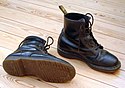
- Doc Martens were dark shoes or boots with air-cushioned soles that were worn by both sexes in the 1980s. They were an essential mode accessory for the skinhead and punk subcultures in the United Kingdom. Sometimes Doc Martens were paired with miniskirts or full, Laura Ashley- style dresses.[56] They were an important characteristic of the postal service-punk 1980s Gothic look which featured long, back-combed hair, pale pare, dark eyeshadow, eyeliner, and lipstick, black smash varnish, spiked bracelets and dog-collars, black clothing (often made of gabardine), and leather or velvet trimmed in lace or fishnet material. Corsets were oft worn past girls. British bands that inspired the gothic trend include The Cure, Siouxsie and the Banshees, and The Cult. This trend would return in the 1990s.
Parachute pants [edit]
Parachute pants are a mode of trousers characterized by the utilize of ripstop nylon or extremely amorphous cuts. In the original tight-fitting, extraneously zippered style of the late 1970s and early 1980s, "parachute" referred to the pants' synthetic nylon material. In the afterward 1980s, "parachute" may take referred to the extreme bagginess of the pant. These are also referred to as "Hammer" pants, due to rapper MC Hammer's signature manner. Hammer pants differ from the parachute pants of the 1970s and early 1980s. They are typically worn as menswear and are often brightly colored. Parachute pants became a fad in Usa culture in the 1980s as office of an increased mainstream popularity of breakdancing.[57]
Unisex accessories [edit]
Jewelry

- Earrings became a mainstream fashion for male teenagers. Jelly or thin metal bracelets (too known every bit bangles) were very popular in the 1980s, and would be worn in mass quantities on one's wrist. Designer jewelry, such as diamonds and pearls, were popular among many women, not but for beauty, but every bit symbols of wealth and power.
Watches
- At the outset of the decade, digital watches with metal bands were the ascendant manner. They remained popular but lost some of their status in later years. Newer digital watches with built-in calculators and primitive data organizers were strictly for gadget geeks. Adult professionals returned to dial watches by mid-decade. Leather straps returned every bit an option. Past the late 1980s, some watch faces had returned to Roman numerals. In contrast, ane ultramodern status symbol was the Movado museum watch. It featured a sleek pattern with a single large dot at twelve o'clock. The Tank watch past Cartier was a mode icon that was revived and frequently seen on Cartier advertisements in print. Rolex watches were prominently seen on the television set show Miami Vice. Teen civilization preferred vibrant plastic Swatch watches. These start appeared in Europe, and reached North America by the mid-1980s. Young people would often wear two or three of these watches on the same arm.[ citation needed ]
Eyewear
- In the kickoff one-half of the 1980s, glasses with big, plastic frames were in fashion for both men and women. Small metal framed glasses made a render to mode in 1984 and 1985, and in the late 1980s, glasses with tortoise-shell coloring became popular. These were smaller and rounder than the type that was popular earlier in the decade. Throughout the 1980s, Ray-Ban Wayfarers were extremely popular, as worn by Tom Cruise in the 1983 motion picture Risky Concern.[ commendation needed ]
- Miami Vice, in particular Sonny Crockett played past Don Johnson, boosted Ray-Ban's popularity past wearing a pair of Ray-Ban Wayfarers (Model L2052, Mock Tortoise),[58] which increased sales of Ray Bans to 720,000 units in 1984.[59]
Subcultures of the 1980s [edit]

English singer Siouxsie Sioux wearing black clothing, dorsum-combed pilus, and heavy blackness eyeliner. She was an inspiration for the gothic fashion trend that started in the early on 1980s.
Robert Smith of the Cure based his gothic wait from Siouxsie Sioux'southward and being a guitarist in her band.
Heavy metal [edit]
- In the first half of the 1980s, long hair, leather rocker jackets (biker jackets) or cut-off denim jackets, tight worn-out jeans, and white, high trainers (sneakers) and badges with logos of favorite metal bands were popular amidst metalheads, and musicians of heavy metallic and speed metallic bands. Withal by the mid 1980s the success of the glam metal scene had influenced the mode worn by many mainstream metal fans. In add-on to the traditional denim and leather wait, mainstream heavy metal bands began to apparel in more vivid, colourful and theatrical clothing similar, in many means, to the glam stone look of the 1970s. This included items such as spandex, platform boots, leg warmers and many different types of oftentimes spiked or studded leather accessories. In addition to this the long pilus pop with metallic fans was often worn teased. Makeup became popular with many metal bands also often worn onstage for theatricality however many bands also began wearing makeup offstage also. The mainstream glam metal image of the mid to tardily 1980s was often criticised by many underground metal fans as being too 'effeminate'. The mainstream glam metal (later chosen 'hair' metallic) style would decline during the later on half of the decade only would remain popular until the grunge movement in the early on 1990s. In the 2d half of the 1980s, the original denim and leather clothing way was popular among musicians and fans of more extreme and niche (often underground) metallic bands – thrash metal, crossover thrash, early black metallic, and early on death metal bands. It was popular particularly in the United States, but at that place were too large regional scenes in Deutschland, England, Canada, and Brazil. Although these styles of farthermost metallic would begin to adopt contrasting images during the ensuing decade.
- By the belatedly 1980s, acid-washed jeans and denim jackets had go popular with both sexes. Acid washing is the process of chemically bleaching the denim, breaking down the cobweb of textile and forcing the dye to fade, thus leaving undertones of the original dye evidenced by pale white streaks or spots on the material. This became associated with the afformentioned heavy metallic trend (called "hair metallic" in later decades for the large frizzy coiffures worn by both male person and female enthusiasts). Severely bleached and ripped jeans, either manufactured purposely or washed by hand, become a popular mode tendency, existence a main component of glam metal music acts such equally Poison.
- The Japanese equivalent of glam metallic, known as visual kei, emerged during the mid to belatedly 80s and incorporated punk, goth and new wave influences.[lx] Brightly dyed, androgynous hair was mutual among shock rock bands similar X Japan, together with studded leather borrowed from fetish mode, traditional Geisha or Japanese opera inspired makeup, drag,[61] and stylized 18th century fop rock costume such as frilly shirts, tall boots and long coats.[62]
Punk [edit]

- Throughout the 1980s, the punk style was popular amid people aged xviii–22. Characterized past multi-colored mohawks, ripped stovepipe jeans, worn ring tee-shirts, and denim or leather jackets. This style was popular amongst people who listened to punk music such equally The Sexual practice Pistols, and later, (despite the ring'due south self-proclaimed rock'due north'roll image) Guns N' Roses. Usually the denim jackets (which became an identity of the group) were adorned by rubber pins, buttons, patches, and several other pieces of music or cultural memorabilia. Oftentimes, fans of the punk style would take random bits of fabric and attach them to their other apparel with safety pins. This soon became a popular way of attaching wear, and it is at present known every bit "pin shirts" with young women. The shirts are, essentially, rectangular pieces of cloth that are pinned on one side with safety pins. In the 1980s, a dressed down look (due east.thou. buzzed hair, T-shirts, jeans and push up shirts) was also very popular with people involved in punk stone, more specifically the hardcore punk scene. The Circle Jerks frontman Keith Morris said "Some of those punk stone kids they interviewed were a piffling over the acme, but the thing historically is – the L.A./Hollywood punk scene was basically based on English fashion. Simply we had nix to do with that. Black flag and the Circle Jerks were so far from that. Nosotros looked like the child who worked at the gas station or submarine store."[63] Punk apparel was not just a style statement. It epitomized a way of thinking and seeing oneself as an individual cultural producer and consumer. In this way, punk style led many people to ask further questions about their civilization and their politics.[64]
New Romantic [edit]
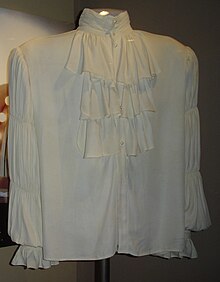
- The origins of the New Romantic and new moving ridge fashion and music movement of the mid 1980s are often attributed to the Blitz Kids who frequented the social club Blitz in London, especially David Bowie. Bowie even used the Blitz'due south host Steve Strange in his music video for Ashes to Ashes.[65] It is also important to note that the New Romantics and those involved with the punk scene had inspired each other because of the concentration of influential individuals going to the same clubs and having the same friend circles.[65] Vivienne Westwood and Malcolm McLaren were also directly involved in the movement, such as dressing the members of Bow Wow Wow. The band leader and later solo artist, Adam Ant, and Westwood had highly influenced each other as well (Adam Ant beingness one of the leading icons of the New Romantics).[66] Westwood'due south first runway collection, Pirates AW 1981-ii is often cited as a New Romantic collection which was both influenced by and highly influential to the movement. The garments in Pirates had asymmetrical necklines, flowy pirate shirts and breeches.[67] The collection was very well received by critics and buyers.[68] However, the designer's interference in the originally DIY way wasn't taken well by some of the participants, such as Boy George who left Bow Wow Wow to grade his own band (Culture Lodge) and who cited one of the reasons for leaving every bit the way Vivienne Westwood wouldn't let him dress himself.[66]
- The Rush Kids described the movement as a retaliation to punk[69] due to it becoming too violent and unsavory crowds such equally neo-Nazis and skinheads deciding to jump on that artful bandwagon.[65] It was also a way to forget their relative poverty following the economic recession and the Winter of Discontent.[69] Features of New Romantic clothing varied from individual to individual, although these generally highlighted the implied individualism, creativity and self-expression of the motion, besides its continued adherence to the DIY ethic of punk.[65] It was inspired past different cultures and fourth dimension periods, films, pic noir, and theatricality. Men oftentimes wore dramatic cosmetics and androgynous clothing, including ruffled poet shirts, red or blue hussar jackets with gold braid, silk sashes, tight pants, shiny rayon waistcoats, and tailcoats based on those worn during the Regency era. Women, too, were very theatrical in terms of makeup and manner, and often favoured big pilus, fishnet gloves, corsets, crushed velvet, and elements of Middle Eastern and gypsy wearable.[66]
Rockabilly [edit]
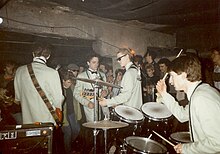
- In the early 1980s, the Teddy Boy look was pop in the Uk among fans of groups similar the Devious Cats, Crazy Cavan, Levi and the Rockats, or Shakin Stevens. Common items of clothing included mantle jackets (generally in darker shades than those of the 1970s), drainpipe trousers, brothel creepers, bolo ties, white T-shirts, baseball jackets, hawaiian shirts, and black leather jackets like the Schott Perfecto. Mutual hairstyles included the quiff, pompadour, flat acme, and ducktail.
- The French rockabilly scene of the early to mid 80s was closely linked with the street punk subculture, had a large black and Arab following, and was involved with antifascist squaddism.[70] The Blackness Dragons identified themselves with the leather jacket wearing greaser antiheroes, rebels and outcasts, and often fought the neonazi skinheads.[71]
Rude boys and skinheads [edit]

British skinheads in 1981
- Post-obit on from the mod revival of the tardily 70s, the UK witnessed a revival of rude boy and skinhead fashion due to the popularity of ska punk, Oi! punk stone, rocksteady, and two tone music during the winter of discontent. In the early 80s, slim fitting mohair, tonic and houndstooth suits[72] were popular, together with basket weave shoes, polo shirts, sta-prest trousers, Physician Martens, braces, Harrington jackets and pork pie hats popularized by bands like the Specials, UB40, the Bosstones, and Madness.[73] In response to the racism of white power skinheads, 1980s rude boys wore checkerboard motifs to signify that both black and white people were welcome. Crew cuts and buzzcuts were worn by both sexes,[74] and girls often incorporated hair bangs in a partially shaven mode known as a Chelsea mohawk.[75] In Brighton, the Skins of the 1980s fought the outlaw bikers and rockabilly guys, as the Mods and Rockers had previously done in the 60s.
Casuals [edit]
- The football game casual subculture first appeared in the UK around 1983, when many ex-skinheads began dressing in designer article of clothing and sportswear to blend into the oversupply and avoid police attending at football games. Popular habiliment for English and Scottish casuals included Burberry coats, Rock Island, Lacoste, Ben Sherman and Fred Perry polo shirts, tracksuits,[76] bomber jackets, Adidas, Nike, or Reebok sneakers, Fila or Ellesse jackets, flat caps, baseball game caps, soccer shirts, and scarfs or bobble hats in their club's colours.[77] Although shaved heads[78] [ self-published source? ] remained the most common haircut, some fans also wore undercuts, Caesar cuts, mod haircuts, and short mullet haircuts. During the late 80s, Casuals mostly listened to acid house, new wave music, and afterwards indie rock[79] or Madchester[80] just a hip-hop influenced offshoot of the subculture, known equally chavs, appeared during the late 1990s and early 2000s.[81] [82]
Skaters [edit]

- In Russia,[83] Commonwealth of australia, East Germany,[84] and America, the skater subculture reached the meridian of popularity in the mid 80s. Unlike the hippie and surfer influenced skaters of the 70s, the skaters of the 80s overwhelmingly preferred sportswear and punk mode, especially baseball game caps, red waffle plaid shirts, sleeveless T-shirts, baggy pants or Jams[85] shorts resembling pajamas,[86] checkered wristbands, striped tube socks, and basketball shoes like Antipodal All Stars and Vans. Brightly colored T-shirts became fashionable by the stop of the decade, often featuring psychedelic eyes, skulls, Ed Roth inspired drawing characters, palm copse, fe crosses, or the logos of skateboard brands similar Stussy,[87] Tony Militarist, Mooks or Santa Cruz.[88] The longer surfer hair was replaced with edgy hardcore punk and street punk inspired styles like the bowl cut or Hitler Youth haircut.
Rap and hip hop [edit]


- Sports shoes had been worn every bit casual wear before, but for the first fourth dimension they became a high-priced mode item. Converse shoes were popular in the first half of the 1980s. In 1984, Nike introduced the first ever Air Hashemite kingdom of jordan sneaker, the Air Jordan 1 (named for basketball player Michael Jordan). Although almost believe this shoe was banned past the NBA due to the sneaker being too flashy and distracting, others believe it was actually, the predecessor, the Nike Air Ship that was under scrutiny.[89] Nike used this controversy between Air Jordan and the NBA to market the sneaker. The Air Jordan ane was released in the imperial blue color manner to the public in 1985 and was an firsthand success, still retaining its value in the manner world today.[90] Soon, other manufacturers introduced premium athletic shoes.
- Adidas sneakers were also a successful brand of the decade, becoming pop among teenage boys and immature men.[ citation needed ] The growth of pop-civilisation and hip-hop influence immune group Run-D.M.C. to make the Adidas Superstar (commonly known as the shell toe) 1 of the most sought-subsequently shoes of the 1980s. Post-obit their unmarried "My Adidas", Adidas reportedly gave them $1 1000000 endorsement bargain.[91] Nike had a like share of the market, with the Air Max and similar shoes such as the Air Strength One which was released in 1982. Loftier-tops, especially of white or black leather, became popular. Other sportswear brands released popular shoes - Reebok had the Reebok Pump, Converse released the Cons and New Residue had the Worthy 790.
- In the early 1980s, long and white athletic socks, oft calf-high or knee joint-high, were worn with sneakers. As the decade progressed, socks trended shorter, somewhen topping out just above the height of the shoe.[ commendation needed ] Run-D.One thousand.C. and other hip-hop groups as well influenced the apparel industry. Wearing track suits and large chains necklaces, they popularised sportswear brands such equally Fila, Puma, Reebok, Nike, Avia and Adidas.[92] Individuals in the civilisation also frequently wore bucket hats, oversized jackets and t-shirts, and loftier contrast colors.[93] Style in hip-hop was a way to surpass the poverty that surrounded the community.[94]
- Co-ordinate to Chandler and Chandler-Smith (2008), rap and hip-hop were non 1 specific way, simply rather a mix between high-end luxury fashion and what was on the street.[95] Harlem designer and shop-owner Dapper Dan embodied this concept by redesigning luxury products and making them available to those who wouldn't typically associate themselves with it. Dapper Dan was most famous for deconstructing a Louis Vuitton garment and turning it into his signature jacket. He reconstructed garments for many music icons and celebrities in the 1980s before getting shut down past lawyers in the early 1990s.[96] This interest in luxury apparel expanded past Dapper Dan - American fashion brands Tommy Hilfiger, Ralph Lauren, and Nautica were expanding rapidly and embraced by hip-hop culture as an indicator of status.[92]
- Ensembles featuring the Pan-African colors - green, yellow and ruby-red, and cherry, blackness and dark-green - became popular among African Americans, as did kente textile. In the urban hip-hop communities, sneakers were commonly worn unlaced and with a large amount of gold jewelry, besides as head wraps.[ citation needed ]
Preppy [edit]

Young Iranian men wearing casual preppy outfits in 1981
- Wealthy teenagers, especially in the United States, wore a style inspired by 1950s Ivy League fashion that came to be known equally "preppy." Preppy fashions are associated with classic and bourgeois style of dressing and clothing brands such as high waisted ankle length jeans and pants evidently or pleated, Izod Lacoste, Brooks Brothers, and Polo Ralph Lauren.[97] An example of preppy attire would be a button-down Oxford cloth shirt, Ascot tie, cuffed khakis, and tasseled loafers, Keds, Sperry or Eastland Boat shoes, white Sperry sneakers, or ballet flats. Throughout the 1980s and 1990s, preppy fashions featured a lot of pastels, turtleneck sweaters for girls, articulatio genus high socks sometimes turned down or folded over at the pinnacle with above the knee length skirts and dresses and polo shirts with designer logos. Other outfits considered "preppy" included cable knit cardigans or argyle pattern sweaters tied loosely around the shoulders,[98] apparel shorts with knee socks, dressed upwardly leggings outfits from the mid 80's on which consisted of leggings with an oversized v-cervix sweater over a turtleneck, slouch socks, Keds (shoes) or Sperrys, and bangs with a headband band or ponytail and scrunchie. The European equivalent, known as Sloane Rangers, dressed similarly but frequently incorporated tweed cloth British country wearable, burberry mackintoshes, mustard corduroy pants, rain boots, padded hairbands, and ancestral jewellery such as pearl necklaces.[99]
Hairstyles [edit]

Women'due south hairstyles [edit]
Although straight hair was the norm at the beginning of the decade, as many late-1970s styles were still relevant, the perm had come into fashion by 1980.
Big and eccentric pilus styles were popularized by film and music stars, in particular amongst teenagers just also adults. These hairstyles became iconic during the mid 1980s and include big bangs worn by girls from upper elementary, center school, loftier school, college and adult women. There was generally an excessive amount of mousse used in styling an private's pilus, which resulted in the popular, shiny look and greater volume. Some mousse even contained glitter.
Commencement in the tardily 80s, high ponytails, side ponytails, and high side ponytails with a scrunchie or headband became common among girls from upper simple, middle school, loftier school, college and adult women.
Men's hairstyles [edit]
By 1983, brusk hair had fabricated a comeback for men, in reaction to the shag and mod haircuts of the mid to late 70s. The sideburns of the 1960s and 1970s saw a massive decline in way, and many guys wore regular haircuts and quiffs. Beards went out of mode due to their association with hippies, but moustaches remained common among blueish collar men.
From the mid 1980s until the early 1990s, mullets were popular in suburban and rural areas amongst working-course men. This contrasted with a conservative look preferred by business professionals, with neatly groomed brusque hair for men and sleek, direct pilus for women. Some men also wore bangs in styles such every bit regular frontal or side swept bangs but they were not as big as women or girls bangs. Hairsprays such as Aqua Internet were also used in excess by fans of glam metal bands such as Poison.
During the tardily 80s, trends in men's facial hair included designer stubble.
Epitome gallery [edit]
-

Daughter in 1980.
-

A French punk, 1981.
-

-

-
-

-

-

Grouping of friends in Italy in 1987.
-

-
-

See also [edit]
- 2000–2009 in fashion
- 1990s in fashion
- 1970s in fashion
Notes [edit]
- ^ Browne, Ray B.; Browne, Pat (15 June 2001). The Guide to The states Popular Culture. Pop Press. pp. 357–. ISBN978-0-87972-821-two . Retrieved 11 August 2012.
- ^ Lauraine Leblanc. Pretty in Punk: Girls' Gender Resistance in a Boys' Subculture. Rutgers University Press, 1999. P. 52
- ^ Brubaker, Ken (ix October 2003). Monster Trucks. MotorBooks International. p. 64. ISBN978-0-7603-1544-6 . Retrieved 10 August 2012.
- ^ Welters, Linda; Cunningham, Patricia A. (20 May 2005). Twentieth-Century American Way. Berg. pp. 223, 337. ISBN978-1-84520-073-2 . Retrieved 10 August 2012.
- ^ Bateman, Antony; Benyahia, Sarah Casey Casey; Mortimer, Claire (23 May 2012). Every bit Media Studies: The Essential Introduction for WJEC. Routledge. p. 111. ISBN978-0-415-61334-7 . Retrieved ten August 2012.
- ^ Steinberg, Shirley R.; Kehler, Michael; Cornish, Lindsay (17 June 2010). Boy Culture: An Encyclopedia. ABC-CLIO. p. 95. ISBN978-0-313-35080-one . Retrieved 10 August 2012.
- ^ a b c d e f chiliad h i j grand l k n "Way in the 1980s". Retrieved 24 April 2014.
- ^ a b "Designer Jeans". Retrieved 7 July 2014.
- ^ a b c "VH1 – I Love The 80s – 1980". YouTube . Retrieved nine July 2014. [ dead YouTube link ]
- ^ Hyde, Nina Southward. (1981-03-24). "Manner: After Jeans...What?". The Washington Post . Retrieved 2022-03-06 .
It doesn't accept a social historian to observe that fewer people are wearing jeans than, say, a few years ago. There are fewer jeans worn to the Kennedy Center, fewer in Georgetown on Saturday afternoon, fewer jeans in high schools. Stores have reported a pass up in sales, especially the designer-label jeans.
- ^ Duka, John (1982-01-03). "Designing an Empire". The New York Times: 20. Retrieved 2021-12-31 .
[Perry Ellis'southward] cropped pants...have been copied by many of the smart manufacturers...
- ^ Hyde, Nina S. (1981-09-24). "Fashion: Growing Into Knickers". The Washington Post . Retrieved 2022-03-06 .
Knickers are hardly a new idea. But not since the Twenties and Thirties, when young boys wore corduroy knickerbockers, have they been so popular.
- ^ Alexander, Ron (1980-06-01). "'Jelly Shoes' In Advised Colors". The New York Times. (complete text)
- ^ "Sexual activity Bracelets". Retrieved ix June 2014.
- ^ "Sweatshirts". Retrieved ix July 2014.
- ^ a b "Leg Warmers". Retrieved 7 July 2014.
- ^ Roland, James. "The History of the Basketball Shoe | LIVESTRONG.COM". Retrieved 2015-05-03 .
- ^ "Trainer Shoes". Retrieved 3 September 2014.
- ^ "Footwear, 1980–2003". Retrieved 3 September 2014.
- ^ a b "Spandex". Retrieved ix July 2014.
- ^ "Fashion in the 1980s, Social and cultural features of the 1980s, Australia'southward social and cultural history in the post-war period, History Year 9, NSW | Online Education Abode Schooling Skwirk Australia". Skwirk.com.au. 1999-03-26. Archived from the original on 2013-xi-12. Retrieved 2014-05-10 .
- ^ Technology and Living – Fashion, Vesture and Textiles Strand (Vol. 6 Culture and Fashion Pattern). Hong Kong Education Agency. 2009.
- ^ "Power Dressing 1980s Fashion History. Fashion-Era". Tomas, P. 2015.
- ^ "1980s Mode History and Lifestyle. Mode-Era". Tomas, P. 2015.
- ^ "1989 Sears Wishbook". www.wishbookweb.com . Retrieved 2017-07-25 .
- ^ "1989 Sears Wishbook". www.wishbookweb.com . Retrieved 2017-07-25 .
- ^ "Mao suit". depts.washington.edu.
- ^ Montefiore, Clarissa Sebag. "From Scarlet Guards to Bond villains: Why the Mao suit endures".
- ^ "Chinese daughter in xanthous".
- ^ "Modernity that is cladded on". Archived from the original on 2016-03-31. Retrieved 2016-01-21 .
- ^ "Chinese 70s fashion". Archived from the original on 2016-03-31. Retrieved 2016-01-21 .
- ^ Crossette, Barbara (21 June 1989). "New Fashion School in India Draws From a Rich Heritage". The New York Times.
- ^ Indian fashion's greatest hits Archived Baronial 3, 2013, at the Wayback Machine
- ^ Mendes, Valerie D.; Haye, Amy De La (17 September 1999). 20th Century Fashion . Thames & Hudson. ISBN9780500203217 – via Internet Annal.
- ^ Jordan, Patti (1 September 2017). "Gender fluidity in men's fashion: From Shakespeare's modernistic English to the new millennium". Critical Studies in Men'southward Manner. iv (2): 171–184. doi:10.1386/csmf.four.ii.171_1.
- ^ a b Sunday, Tiantian (May 2013). East Meets West: The Influence from Japanese Traditional Kimono to 1980s Japanese Fashion Designers and Further Influence Western Fashion (Thesis).
- ^ Japanese way in the Met Museum
- ^ "The Cut Edge: Fashion From Nippon". designtaxi.com.
- ^ "2013 - Volume twoscore - Google Drive". bulldoze.google.com. [ full citation needed ]
- ^ a b "The Japanese Revolution in Paris Fashion, Yuniwa Kawamura". www.transitionandinfluenceprojects.com.
- ^ Craik, Jennifer (2005). Uniforms Exposed (Clothes, Torso, Culture). Oxford, UK: Berg Publishers. p. 171. ISBN1-85973-804-4.
- ^ a b "Cowboy Boots". Retrieved 9 July 2014.
- ^ "New wave makeup".
- ^ "Totally 80s: New Wave". Archived from the original on 7 January 2015. Retrieved 4 October 2014.
- ^ "80s' Fashion for Men". Retrieved 20 May 2014.
- ^ a b c Manner and style. "The rehabilitation of the power accommodate". Telegraph. Retrieved 2014-05-ten .
- ^ a b c "The History of the Power Suit ~ Levo League". Levo.com. 2014-03-06. Archived from the original on 2014-05-13. Retrieved 2014-05-10 .
- ^ "Power Suit – Voguepedia". Vogue.com. Archived from the original on 2014-02-02. Retrieved 2014-08-12 .
- ^ "Way : les nostalgiques des années 70 exhument l'Abacost - adiac-congo.com : toute l'actualité du Bassin du Congo". adiac-congo.com.
- ^ Congo sapeur way
- ^ "Les Sapeurs: Bringing subversive style to the Eastern Congo".
- ^ Doig, Stephen (17 September 2018). "Meet the dandies of Brazzaville" – via world wide web.telegraph.co.uk.
- ^ Brownish, DeSoto; Linda Arthur (2002). The Art of the Aloha Shirt. Island Heritage Publishing. ISBN 0-89610-406-0. Page 79
- ^ Restrepo, Laura (17 September 1986). Colombia, historia de una traición. IEPALA Editorial. ISBN9788485436347 – via Google Books.
- ^ "History of Miami". Archived from the original on 2012-07-21. Retrieved 2016-04-25 .
- ^ Fashion-Era.com
- ^ Mansour, David (June 2005). "Parachute pants". From Abba to Zoom: A Pop Culture Encyclopedia of the Belatedly 20th Century. p. 353. ISBN9780740751189 . Retrieved 13 January 2011.
- ^ "South Embankment and 'Miami Vice,' past and present". USA Today. www.usatoday.com. 2006-09-29. Retrieved 2007-xi-25 .
- ^ Leinster, Colin (1987-09-28). "A Tale of Mice and Lens". Fortune Mag. money.cnn.com. Archived from the original on 31 Oct 2007. Retrieved 2007-11-25 .
- ^ Strauss, Neil (18 June 1998). "THE Pop LIFE; End of a Life, Stop of an Era". The New York Times.
- ^ "Japanese Stone on NPR".
- ^ Hughes, Felicity (26 Oct 2010). "Scene and heard: Visual kei". The Guardian.
- ^ Prindle, Marker. "Keith Morris – 2003". Interview. Mark Prindle. Retrieved 2013-ten-twenty .
- ^ Mattson, Kevin (Jump 2001). "Did Punk Matter?; Analyzing the Practices of a Youth Subculture During the 1980s". American Studies. 1. 42 (one): 77. JSTOR 40643156.
- ^ a b c d [Strange, Southward., & Egan, R. (2010, May 15). It's rush: Birth of the new romantics (Interview by P. Elan). The Guardian. Retrieved from https://world wide web.theguardian.com/music/2010/may/xv/blitz-male child-george-steve-strange-visage ]
- ^ a b c Bromley, I., & Wojciechowska, D. (2008). Very vintage: The guide to vintage patterns and clothing. London, United kingdom of great britain and northern ireland: Blackness Dog.
- ^ History: Early on years. (2017). Retrieved Apr ten, 2017, from Vivienne Westwood website: http://www.viviennewestwood.com/en-gb/history/early-years Archived 2017-04-twenty at the Wayback Machine
- ^ Mendes, Five., & de la Haye, A. (2010). Thames&Hudson earth of art: Way since 1900s (2nd ed.). Thames & Hudson. (Original work published 1999)
- ^ a b crane.boob tube. (2013, July 11). Order to catwalk | Blitz kids [Video file]. Retrieved from https://www.youtube.com/watch?v=hkeM_-wVgWU
- ^ "Black Dragons: The Black Punk Gang Who Fought Racism & Skinheads in 1980s France". 10 August 2016.
- ^ "Chasing Skinheads with the Black Dragons in 1980s Paris". 29 July 2015.
- ^ Misiroglu, Gina (26 March 2015). American Countercultures: An Encyclopedia of Nonconformists, Alternative Lifestyles, and Radical Ideas in U.S. History: An Encyclopedia of Nonconformists, Alternative Lifestyles, and Radical Ideas in U.S. History. Routledge. ISBN9781317477297 – via Google Books.
- ^ Augustyn, Heather (x Jan 2014). Ska: An Oral History. McFarland. ISBN9780786461974 – via Google Books.
- ^ Augustyn, Heather (12 September 2013). Ska: The Rhythm of Liberation. Scarecrow Printing. ISBN9780810884502 – via Google Books.
- ^ "The rise of the Skinhead: Photos document the controversial youth cult - Folio iii of 3". 10 July 2016. Archived from the original on ii February 2017. Retrieved 27 January 2017.
- ^ Solomons, Jason (13 August 2005). "Casual dress essential". The Guardian.
- ^ "Emotional hooliganism".
- ^ Gough, Meic (1 April 2007). Patches Checks and Violence. Lulu.com. ISBN9781847531865 – via Google Books. [ self-published source ]
- ^ The Scotsman
- ^ "Football game Casuals- 80s Casuals". www.football game-hooligan.com.
- ^ "Burberry versus The Chavs". 28 October 2005 – via news.bbc.co.uk.
- ^ Daubney, Martin (25 February 2015). "White male football fans: the scum it's dandy to hate" – via www.telegraph.co.uk.
- ^ "Skate USSR: discover the Soviet subculture you never knew existed".
- ^ "East Germany'southward Cloak-and-dagger Police Used to Spy On Skateboarders". 26 November 2013.
- ^ "Jams Shorts – an 80s summer fashion must have for both men and women!". 22 May 2010.
- ^ Moore, Jennifer Grayer (fourteen Dec 2015). Style Fads Through American History: Fitting Dress into Context: Fitting Apparel into Context. ABC-CLIO. ISBN9781610699020 – via Google Books.
- ^ "How skaters brutal from mode". The Age. xi January 2003.
- ^ Vintage T-shirts
- ^ "Jordan 1 Banned Complete History | SneakerNews.com". Sneaker News. 2016-09-01. Retrieved 2017-10-07 .
- ^ Martin, Jake Woolf, Matt (2017-03-31). "The Air Jordan 1 "Royal" From 2001 Is Still the Best—Here's Why". GQ . Retrieved 2017-x-07 .
- ^ "How Has Hip Hop Influenced Manner? | LEAFtv". LEAFtv . Retrieved 2017-x-07 .
- ^ a b "How Rappers Took Over Way | Highsnobiety". Highsnobiety. 2017-x-07. Retrieved 2017-10-07 .
- ^ Sacasa, Edwin (2013). Shirt Kings: pioneers of hip hop fashion. Arsta: Dokument Press. ISBN9789185639571.
- ^ Cochrane, Lauren (2015-10-27). "And then fresh and so clean: a brief history of fashion and hip-hop". The Guardian. ISSN 0261-3077. Retrieved 2017-10-07 .
- ^ Chandler, Robin (2008). Flava in Ya Gear: Transgressive Politics and the Influence of Hip-Hop on Gimmicky Style. Cunningham: 50. Welters & P.A.
- ^ Cooper, Barry Michael (2017-06-03). "The Fashion Outlaw Dapper Dan". The New York Times. ISSN 0362-4331. Retrieved 2017-10-07 .
- ^ Peterson, Amy T., and Ann T. Kellogg (2008). The Greenwood Encyclopedia of Clothing Through American History 1900 to the Present: 1900–1949. ABC-CLIO. p. 285. ISBN 9780313043345
- ^ "camillereads.com". world wide web.camillereads.com.
- ^ Jardine, Cassandra (iii October 2007). "Ann Barr: The woman who invented Sloanes" – via www.telegraph.co.uk.
References [edit]
- John Peacock, Fashion Sourebook: The 1980s, ISBN 0-500-28076-2 (October 1, 1998)
- Tom Tierney, Bully Fashion Designs of the Eighties, ISBN 0-486-40074-3 (March 18, 1998)
- Catherine McDermott, Made in Britain: Tradition and Style in Contemporary British Manner, ISBN 1-84000-545-ix
- Breward, Christopher, Style, ISBN 0-19-284030-four (June 1, 2007)
External links [edit]
- Children's vesture from the 1980s
- "1980s – 20th Century Fashion Drawing and Illustration". Style, Jewellery & Accessories. Victoria and Albert Museum. Archived from the original on 8 January 2011. Retrieved 2011-04-03 .
0 Response to "What Is the Fashion in the 80S Called"
Post a Comment